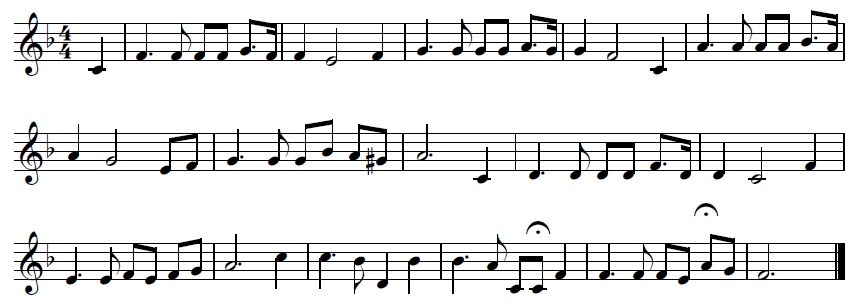
'Myfanwy' is a song well-known to all followers of Welsh rugby: it is frequently sung at the Principality Stadium at home games. It was published in 1875 as a part-song for four male singers, and has since become a staple of Welsh male-voice choirs. The words were written by Richard Davies (bardic name 'Mynydddog'), and the music was composed by Joseph Parry. However, a set of English words, with the title 'Arabella', written by Thomas Pryce (bardic name 'Cuhelyn'), were published with the Welsh ones, and there is doubt whether Parry wrote the music initially for the Welsh or English words. The melody line of the song has been sung as a solo by many performers. The original melody was in the key of Db major, which is far too high for my voice, so I've transposed it to F major. I've also added a pause in the third bar from the end, as all performers now seem to do that.
Lyrics
1. Paham mae dicter, O Myfanwy,			Why is anger, O Myfanwy,
Yn llenwi'th lygaid duon di?			Filling your dark eyes?
A'th ruddiau tirion, O Myfanwy,			And your gentle cheeks, O Myfanwy,
Heb wrido wrth fy ngweled i?			Without blushing when seeing me?
Pa le mae'r wên oedd ar dy wefus		Where is the smile that was on your lips
Fu'n cynnau 'nghariad ffyddlon ffôl?		That kindled my foolish faithful love?
Pa le mae sain dy eiriau melys,			Where is the sound of your sweet words,
Fu'n denu nghalon ar dy ôl?			That drew my heart after you?

2. Pa beth a wneuthum, O Myfanwy,		What have I done, O Myfanwy,
I haeddu gwg dy ddwyrudd hardd?			To earn the frown of your lovely cheeks?
Ai chwarae oeddit, O Myfanwy,			Were you playing, O Myfanwy,
 thanau euraidd serch dy fardd?		With the golden fires of your poet's love?
Wyt eiddo i'm drwy gywir amod:			You are mine through right proviso:
Ai gormod cadw'th air i mi?			Is it too much to keep your word to me?
Ni cheisiaf fyth mo'th law, Myfanwy,		I shall never seek your hand, Myfanwy,
Heb gael dy galon gyda hi.			Without getting your heart with it.

3. Myfanwy, boed yr holl o'th fywyd		Myfanwy, may all of your life
Dan heulwen ddisglair canol dydd;		Be beneath the bright midday sun;
A boed i rosyn gwridog iechyd			And may the rosy roses of health
I ddawnsio ganmlwydd ar dy rudd.		Dance for a hundred years on your cheeks.
Anghofia'r oll o'th addewidion			Forget all of your promises
A wneist i rywun, eneth ddel,			That you made to anyone, pretty girl,
A dyro'th law, Myfanwy dirion,			And give your hand, sweet Myfanwy,
I ddim ond dweud y gair "Ffarwél".		Just to say the word "Farewell".
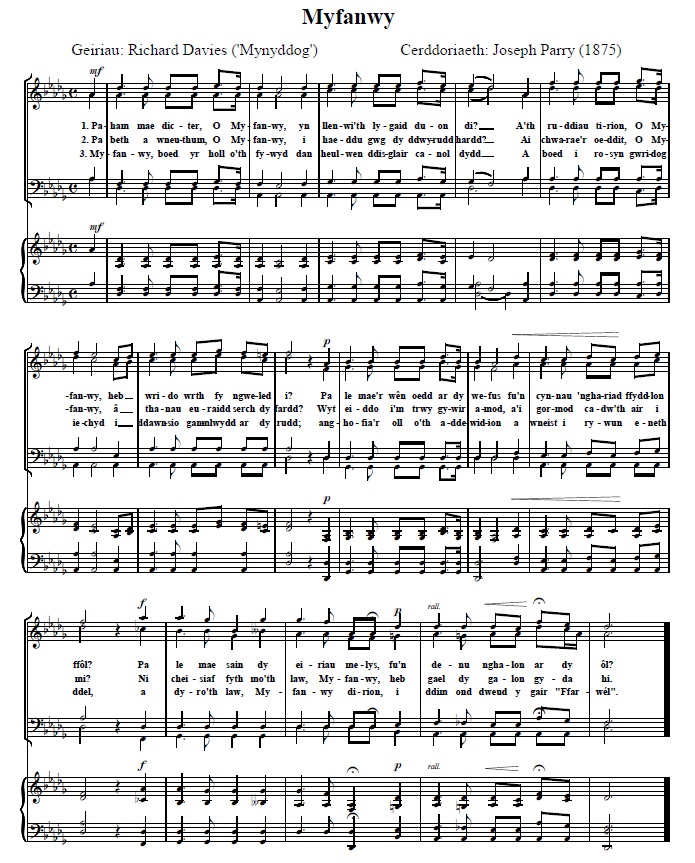
Note that the name "Myfanwy" itself is pronounced with the "w" as a vowel, "oo", rather than a consonant as in English. In Verse 3, many versions on the Internet have "disglair" (un-mutated) rather than "ddisglair", and "ienctid" in place of "iechyd". But these do not appear in the original. The version above comes from a reprint of the original, published in 1931, with a few spelling modernizations listed below with the full score. Two further modifications appear frequently in current recordings: "Ni fynaf byth" (I shall never take) instead of "Ni cheisiaf fyth" (I shall never seek), and "'ngeneth ddel" (my pretty girl) instead of "eneth ddel" (pretty girl).
"Paham" is an alternative to 'pam', meaning 'why', and is used here for the scansion.
The appended form "-th" is an alternative to 'dy', meaning 'your' or 'thy', and causes a soft mutation in the same way.
"Duon" is the plural form of 'du', meaning 'black' or 'dark'. Plural forms of few adjectives are used in modern Welsh, but several adjectives of colour have them, such as 'gwynion' for 'white' and 'cochion' for red.
"Bu" (mutating to "fu") is the third person singular of the literary version of the past of 'bod', usually not heard much in spoken Welsh now, except for phrases like 'bu marw fo' (he died).
"Wnaethum" is the literary version of 'dw i wedi gwneud' (I have done).
"Dwyrudd" is an alternative form of 'gruddiau' (cheeks), rather like 'dwylo' is the plural form of 'llaw' (hands).
"Ai chwarae oeddit" means literally 'Is it playing you were', using the word 'ai' (it is), and the literary 'oeddit' in place of the informal 'oeddet ti' (you were).
"Wyt eiddo i'm drwy gywir amod" literally means 'You are mine through right proviso'.
"Mo" is short for 'dim o'.
"Boed" is the third-person singular imperative of bod, meaning 'Let it be'.
"Anghofia" can mean either 'forget' as a second-person singular command, or 'I will forget'; here it is taken to mean the former.
"Dyro" is the second-person singular imperative of rhoi, an alternative to 'rhoi'.
Vocabulary
Dicter Anger (m, dicterau)
Grudd Cheek (f, gruddiau)
Tirion Gentle, Considerate
Gwrido To blush, flush
Gwên Smile (f, gwenau)
Gwefus Lip (f, gwefusau)
Cynnau To ignite, kindle
Sain Sound (f, seiniau)
Denu To entice, draw, tempt
Haeddu To deserve
Gwg Frown (m, gygau)
Dwyrudd Cheeks (cf. dwylo = hands)
Euraidd Golden (usually euraid)
Eiddo Property (m)
Amod Condition, proviso (m, amodau)
Boed May (usually bydded, from bod)
Gwridog Rosy
Ganmlwydd Century (m, ganmlwyddiant)
Addewid Promise (g/b, addewidion)
Variations
Here is the published four-part score in the original key (from a 1931 reprint of the original), with the following amendments to modernize the language.