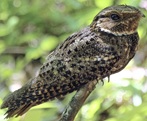
Eastern Whip-poor-will
The lyrics of 'Moliannwn' (Let Us Rejoice) were written by Benjamin Thomas (1838-1920), a slate quarryman from Bethesda, North Wales, who spent approximately 50 years living in the Slate Valley region of Vermont and New York.
While the song is a celebration of spring, it reflects Thomas's life in America. He included local wildlife he encountered there, such as grasshoppers, toads, and the Whip-poor-will (a species of nightjar). Thomas set his Welsh lyrics to a traditional American tune called 'The Old Cabin Home'. There is an article on the Slate Valley Museum website that expands on the origins of the song. Despite its American origins, the song became a massive hit in Wales and remains a popular drinking song often heard in pubs and at rugby matches.
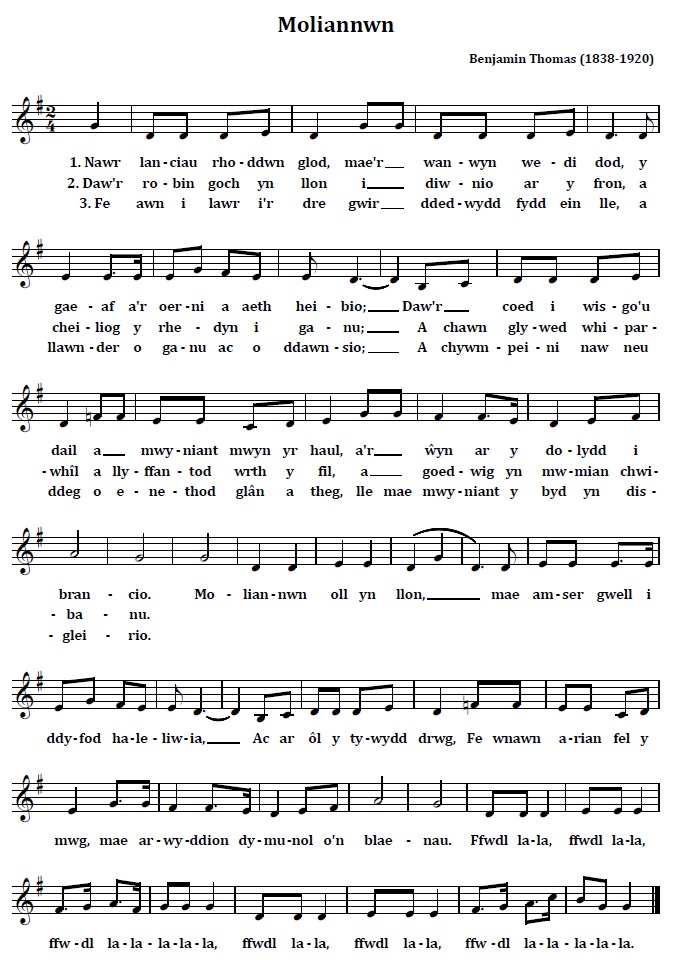
Lyrics
1. Nawr lanciau rhoddwn glod,		Now young men we give credit,
Y mae'r gwanwyn wedi dod,		Spring has come,
Y gaeaf a'r oerni a aeth heibio.	The winter and the cold has passed.
Daw'r coed i wisgo'u dail,		The trees come to wear their leaves,
A mwyniant mwyn yr haul,		And the pleasant enjoyment of the sunshine,
A'r ŵyn ar y dolydd i brancio.		And the lambs on the meadows to gambol.

	Moliannwn oll yn llon,			We all praise with joy,
	Mae amser gwell i ddyfod, Haleliewia,	A better time is coming, Hallelujah,
	Ac ar ôl y tywydd drwg,			And after the bad weather,
	Fe wnawn arian fel y mwg,		We'll make money hand over fist,
	Mae arwyddion dymunol o'n blaenau,	There are pleasant signs ahead,
	Ffwdl-la-la, ffwdl-la-la, ffwdl la-la-la-la-la; (x2)

2. Daw'r robin goch yn llon,		The robin becomes merry,
I diwnio ar y fron,			To tune on the breast,
A cheiliog y rhedyn i ganu,		And the grasshopper to sing,
A chawn glywed whiparwhîl,		And we get to hear whip-poor-will,
A llyffantod wrth y fil,		And frogs by the thousand,
O'r goedwig yn mwmian, chwibanu.		From the forest humming, whistling

3. Fe awn i lawr i'r dre,		We'll go down to town,
Gwir ddedwydd fydd ein lle,		True happiness will be our place,
A llawnder o ganu ac o ddawnsio.	And full of singing and dancing.
A chwmpeini naw neu ddeg		And the company of nine or ten
O enethod glân a theg,			Clean and fair girls,
Lle mae mwyniant y byd yn disgleirio.	Where the world's enjoyment shines.
Variations
The lyrics are remarkably consistent across the many versions preformed or available on the Internet. The nonsense words in the chorus are an exception though, with varieties like "Ffa", "Ffw", "Ffwl" and "Ffwdl", and with either 5 or 6 "la"s at the end. The spelling of "whiparwhîl" also varies, but this is the official version in the GPC.
Recordings
Cerys Matthews sung it with accompaniment and some harmonization on her CD 'Hullabaloo' (2014).
The choir 'Eryrod Meirion' gave a light male-voice-choir version on 2023.
Tammy Jones sang it with spoons accompaniment and a backing band on the S4C programme 'Heno' in 1993.
Notes for Welsh learners
The phrase "gwneud arian fel y mwg" (making money like smoke) is a Welsh idiom for making money very quickly; note that there is no circumflex, because 'mŵg' means 'mug'.
The title of the song, "Moliannwn", is the first-person plural exhortative of 'moliannu', meaning 'let us praise'; it's very literary, and gives a hymn or carol feel; everyday Welsh would use 'gadewch i ni foli'.
The Welsh name "whiparwhîl" for the whip-poor-whil (a species of nightjar) is derived from the onomatopoeic English name, and unusually for Welsh has the combination of 'w' and 'h'.
"Tiwnio ar y fron" literally means 'singing from the breast', i.e. 'singing heartily'.
Vocabulary
Llanc young man (m, llanciau)
Clod praise (m, clodydd)
Oerni cold, coldness (m)
Mwyniant pleasure, enjoyment (m, mwyniannau)
Mwyn tender, mild, fair, pleasant, soothing
Oen lamb (m, ŵyn)
Prancio gamble, prance
Arwydd (m, arwyddion)
Dymunol agreeable, pleasant
Whiparwhîl whip-poor-will (m, whiparwilod)
Ceiliog y rhedyn grasshopper (m, ceiliogod y rhedyn); "rhedyn" is the plural of 'rhedynen' (fern, bracken)